LIPOCLINIC St. Gallen
9000 St. Gallen
LIPOCLINIC Zürich
8004 Zürich

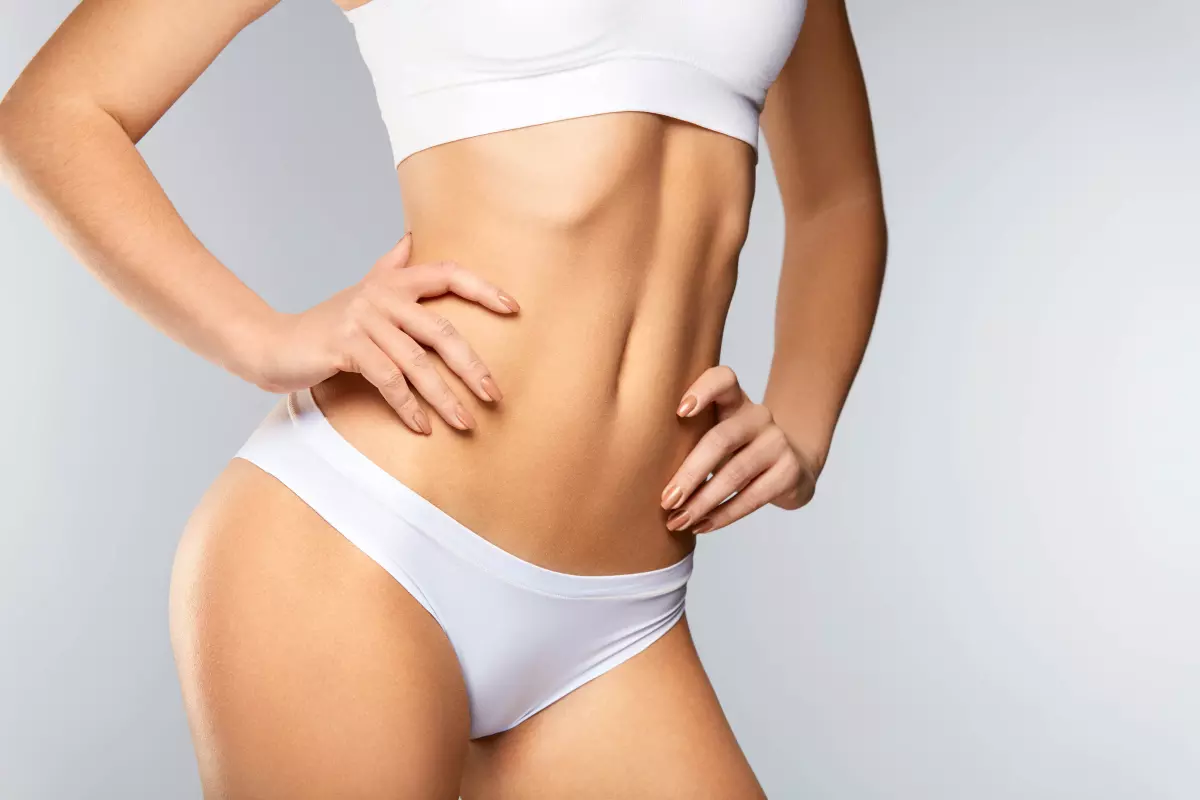
Many patients are unsure whether what bothers them is excess skin or excess fatty tissue. At first glance, the two can look very similar and are therefore often confused with one another.
Especially after changes in weight, with increasing age or due to genetic factors, certain areas of the body may no longer appear as firm as desired. However, the cause is not always fatty tissue – often it is loose or excess skin.
Below, we explain how to distinguish between excess skin and fat that can be removed by liposuction, and which treatment options may be appropriate in each case.
Directly beneath the epidermis lies the dermis. It is usually 2–4 mm thick, but in individual cases it can also be thicker, referred to as a “thick skin layer”. This cannot be removed, as it is constitutional, and can only be reduced through strict dieting. Neither liposuction, ultrasound nor fat-dissolving injections can reduce the dermis. It contains a large network of blood vessels known as the “reticular plexus”. If liposuction is performed too superficially, this vascular network can be destroyed. The consequences are permanent blue or red discolouration of the skin, which unfortunately will never disappear. For this reason, this area should never be damaged when treating the fat.
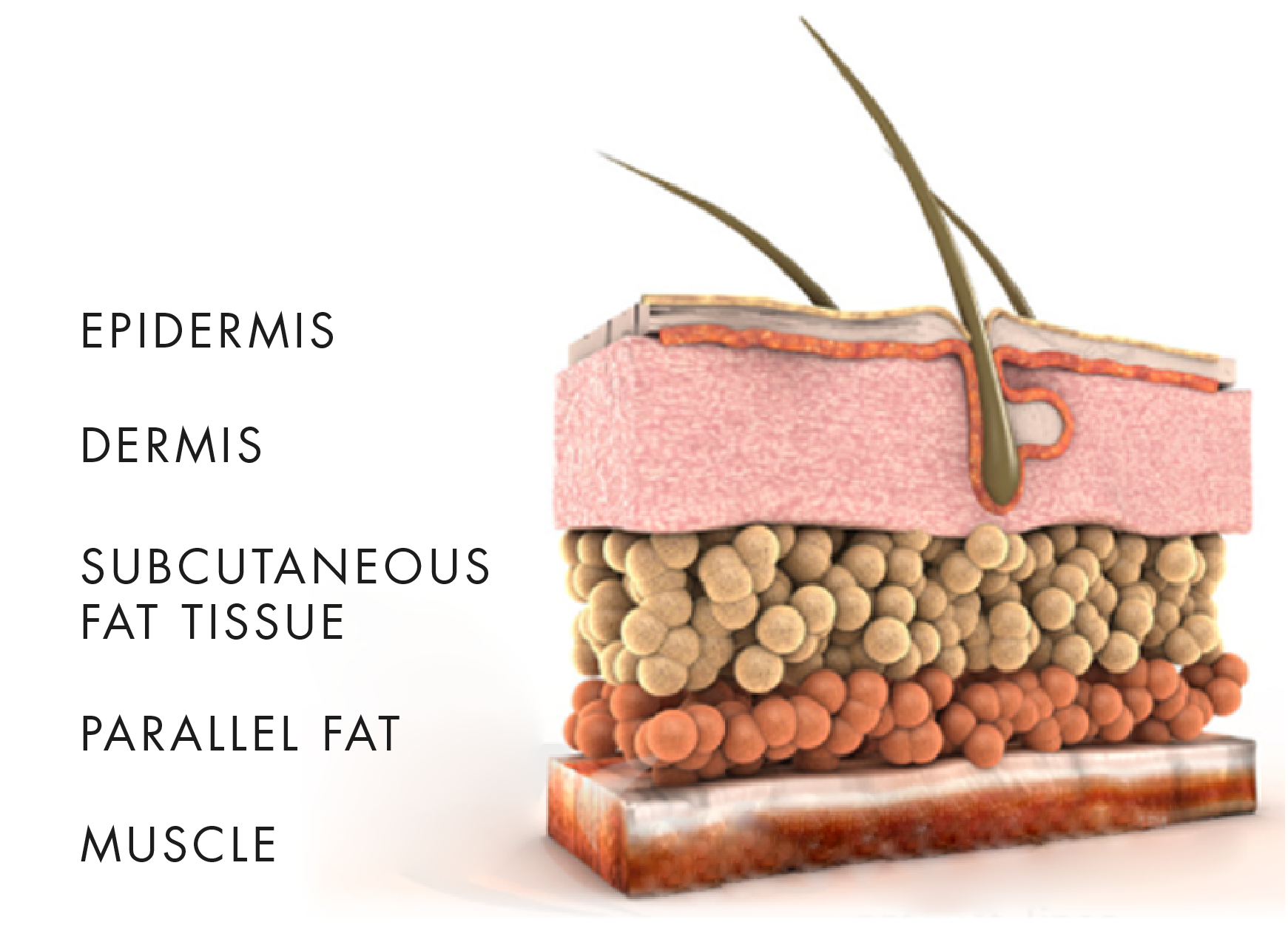
Under the dermis is the subcutaneous layer: It is this layer that can be treated with liposuction, cryolipolysis, ultrasound or fat-away injections.
The epidermis and dermis can often lead to a rather thick layer when "pinching": However, this is not fat, but skin. As liposuction can only reduce fat, there will be little difference if the unwanted volume is largely skin-based.

Please note that the real fat layer is only half as thick as the wrinkle thickness you hold in your hand during the pinch test. In the above case, the problem is not fat, but shifting skin.
When you pinch the skin, you compress the real subcutaneous fat layer and thus double its thickness, but this does not correspond to reality. In such cases, removing the fat has virtually no effect, as this skin fold is formed entirely by the epidermis and dermis.
Liposuction usually produces sensational results when it is the subcutaneous fatty tissue that forms the troublesome fat pads. However, excess epidermis and subcutaneous tissue can never be treated.
If you are unsure whether you have fat or just too much skin, this can be examined in detail: A fat clamp measures the exact fat layer of the skin. Alternatively, the fat can also be measured by ultrasound and the fat layer can be precisely determined in the image.
Unfortunately, these anatomical conditions – i.e., the confusion between sagging skin and the subcutaneous fat layer – often lead to misunderstandings among patients, because different results are expected than the procedures that reduce the subcutaneous fat layer allow.
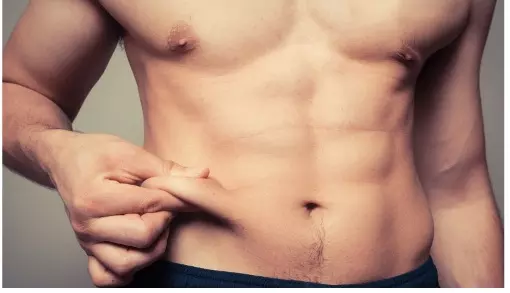
Here is an example of a slim, defined body. This skin fold is not a fat fold and liposuction would not achieve anything here.
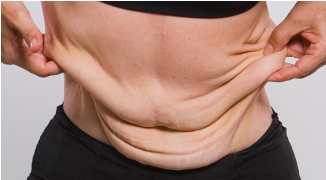
Here is another example of a skin problem that is not fat-based. Here, too, treatment of the subcutaneous fatty tissue would not produce any results.
"Pseudo fat" always leads to frustration, especially on the abdomen and sides (waist, "love handles"). After the liposuction, fat still "hangs down" over the sides of the trousers. When naked, the body looks very good, but when dressed in tight jeans, the fat seems to be back. "Pseudo-fat" describes the condition of some areas of the body that are often misinterpreted as fat, but are in fact shifting skin. "Pseudo-fat" is very often confused with residual fat pads, but further liposuction would not produce any results.
Typical areas:
There are essentially only two options for treating excess skin: surgical skin removal or modern minimally invasive skin tightening.
The traditional method is the surgical removal of excess skin with a scalpel. The skin is surgically removed, for example from the abdomen or arms. It is important to know that this is a major operation performed under general anaesthesia. Although it can be effective, it usually leaves clearly visible scars.
A modern alternative is skin tightening with RENUVION, currently one of the most advanced procedures for minimally invasive skin tightening. The tissue is heated in a controlled manner using a combination of radiofrequency energy and helium plasma. This heat causes the collagen fibres to contract, making the skin contract and become firmer – similar to a steak contracting on a grill.
The results are often very good but always individual, as the degree of tightening is physically limited – similar to a steak, which can only contract to a certain extent when exposed to heat. Depending on the result, the treatment can be repeated if necessary.
RENUVION can also be combined effectively with other modern skin-improvement procedures, such as Morpheus8 (radiofrequency microneedling) or collagen boosters, to further improve skin structure and stimulate collagen production.
We understand that aesthetic treatment needs to be carefully considered. We are therefore happy to take the time to answer all your questions during a free, no-obligation initial consultation. Arrange your consultation appointment today at one of our two LIPOCLINICs.
If you would like a brief online preliminary clarification before your consultation, you can also contact us by e-mail.
No matter how you want to reach us – we look forward to hearing/reading from you!


